The title and the URL of this blog need explanation. First, although I call it "AntiBlog," I am NOT against blogging. Unlike most blogs, I don't WANT people to read this blog. Second, "If you care what I think ..." doesn't imply I WANT you to care what I think. I prefer if you didn't care what I think. I am blogging purely for myself. Since my thoughts frequently change, don't hold me to anything I write here. This is just a fleeting representation of my random thoughts when I write them.
Friday, March 11, 2016
Locally Laid - A Horror-Tragi-Comedy Love Story that Teaches ...
Friday, January 29, 2016
Prof. R. Srinivasan (Part 5)
Father was a writer too. He regularly wrote articles for Tamil and English magazines. His articles for the Bhavan's Journal were later compiled and published as a book titled The Facets of Indian Culture.
Father has written a book on kathakalakshepam, in English. He collected a set of his own bhajans, as well as traditional bhajans, and this was published as a book by the Salem Theosophical Lodge. He wrote stories and articles on kavadi chindu, pop music, etc. for Tamil magazines like Kaveri, whoch was published in Kumbakonam, and also Kumudam.
Father was a composer too. He composed many songs in Tamil and Sanskrit. In those days, a composer would compose the lyrics, music, tala, everything. Not like today where the lyric is written by someone and the music composed by another, and so on.
I have published 51 of Father's compositions, with notation, as a book. This book was released in 1954 at Kalakshetra in Adyar by Musiri Subrahmania Iyer. Father was particular that the function be held where people of music were present, and rejected the suggestion by some friends that politicians should be invited. Tiger Varadachariar, Mysore Vasudevachar, and Buldur Krishnamurthy Sastrigal were some of the stalwarts who attended the function. That evening, I sang some of Father's compositions for an hour, with Varahur Muthuswamy Iyer (violin) and Karaikudi Muthu Iyer (mridanga) as accompanists. These two used to accmompany me in many of my concerts in Madras. The function was a big success. Rukmini Devi, whom father had known for long, was also present. Father also served as Director of Kalakshetra for one or two years.
Unfinished post - I found this "unpublished post" in 2022. I'll try and see if I can finish it one of these days.
Friday, August 15, 2014
Open Letter to the City of Duluth Parking Violations Bureau
Wednesday, May 1, 2013
R. Srinivasan: A Profile (Part 4)
PART 4
Prof. R. Srinivasan
(1887-1975)
Father was a Harikatha performer also. He had a close friend, named Rangu, I think, who used to sing quite well and Father used to say that he was his "first guru." Once, these two had attended a kathakalakshepam by someone in Srirangam. The performer committed some mistake and the boys had the audacity to laugh. The performer became very angry and retorted: "how dare you laugh? You would know the difficulty if you took the 'chipla' in your hands!" Father took this as a challenge and promised to do a Harikatha kalakshepam in the same place in a month's time. And he did! His friend gave him vocal support. This was the beginning. He was then 16 years old. After settling down in Tiruvanantapuram, he used to perform Harikatha regularly, especially during the Onam celebrations. He once performed Nandan Charitram for three days.
Father felt that Harikathas like Seetha Kalyanam, Rukmini Kalyanam, and Nandan Chritram were being repeated again and again. He also wanted to establish another point through his Harikathas, since some persons said that god showing himself to humans and working miracles all happened ages ago and only in stories and they were no longer relevant. Father believed that god is ever bestowing his blessings on his true bhaktas, So he was on the lookout for stories which would prove this. He selected some seven stories, developed them, composed songs for them and presented them in kathakalshepams. These were authentic stories which happened within the last 500 years.
- Story 1: "Senan" was Akbar's barber. Lord Krishna gave him darsan. And through him, to Akbar also.
- Story 2: Tulukka Nachiyar. She was a Muslim princess. When the Muslims invaded the area around Srirangam, there was an idol of Lord Ranganatha among their booty. Her nanny, a Hindu woman, told her many wonderful stories about the Lord. The princess was enamoured and woudl always play with this idol. When she attained marriageable age, her father arranged her wedding. But the princess announced that she was already wedded to Lord Ranganatha and would not marry anyone else. The father, taking this to be a mere child's prattle, went ahead with his preparations. At this, the princess, along with her nanny, left for Srirangam on horseback without anyone's knowledge. At the temple, she fell at the Lord's feet, saying, "I'm surrenderign myself to you, do what you will with me." And she became one with Him. [As evidence of this marriage, three practices associated with Muslims are in vogue at the temple even today. During abhisheka, a lungi is tied to the Moolavar [principal deity). The first neiveidyam in the morning is maida roti and butter. During the shodasopachara, when paan or betel leaf is offered to the Lord, the lime paste is applied on the smooth side as Muslims do, and not on the rough side, as done by the Hindus. Tulukka Nachiyar's sannidhi is in the first prakara, close to the main sanctum sanctorum, in precedence over the other consorts. In this first prakara, all the lamps are lit with ghee and not oil.]
- Story 3: The Madurantakm Miracle. There is a temple for Seeta Devi near Madurantakam, not too far from Madras. It was in a dilapidated condition. For Lionel Place, the Collector of Chengalpettu who had seen churches of great splendour in his native England, this temple appeared most unimpressive. An elderly man told him, "This is Seeta Devi's temple, she is a giver of boons." When the Colonel asked him if she would grant even his wish, the old man answered, "She will indeed, if you ask with true faith." The Colonel said that if she could guard the lake from bursting during the monsoon, he would himself renovate the temple. When the monsoon arrived and with it the floods, he went and stood in person to check the bund, when Rama and Lakshmana gave him darsan. And the bund did not break. The lake was full to the brim, but did not overflow. So, to fulfill his promise, he rebuilt the temple out of his own money. One can see on the foundation stone even today, the following inscription: "Col. Lionel Place's dharmam." Prof. Srinivasan once performed this story in the temple precincts itself. And he composed a song in English for his story.
- Story 4: At the Tirukoil in Kadirgamam in Sri Lanka (Subramania Swamy temple), a mother-daughter duo were doing the daily cleaning of the temple premises, getting flowers, etc. After the mother died, the girl continued this kainkaryam (service). She spent all her life there, and when she became very old, the trustees felt she should be given a pension and sent away and a new servant appointed. When she was informed of this, she could not bear that she would not be allowed to the work anymore. She appealed to the Lord: "I've been serving you since childhood. All I want is to serve you till I die. Is that too much to ask?" So crying, she fell unconscious at the Lord's feet. Next morning when she woke up, a miracle had taken place! She had regained the physical form of a 10-year old. She looked as she had when she first came to work at the temple. After which, of course, there was no question of retiring her due to old age, and she continued to serve her Lord. This incident was taken from a news item from a Ceylon newspaper, a cutting of which was sent to Father by a friend of his.
- Story 5: This was based on Gopalankutty's story in the Malayalam Standard II text book. A boy, who was scared to take a forest path on the way to school, was advised by his mother to call to his elder brother Gopalan, who would accompany him and guard him. In all innocence, the boy called out to Gopalan and Lord Krishna in the guise of a shepherd accompanied him in the forest path. This continued daily. And finally, Krishna appeared before his unbelieving parents too and blessed them!
- Story 6: There is a Sakshi Gopalan temple in Cuttack. A guru promised his daughter's hand in marriage to his disciple, with the Lord as their witness. Then the guru left on a long pilgrimage. On his return, the disciple reminded him of the promise. The guru tried to wriggle out of the promise, pretending not to remember. So the disciple called on god, who was their witness. God appeared in person and gave evidence that such a promise had indeed been made and got the guru's daughter married to the disciple.
- Story 7: This story concerned Sree Raghavendra of Mantralaya. The large tract of land belonging to the temple was lying waste. So the Government wanted to acquire it and develop it for some useful purpose. Governor Monroe went there to inspect the land. When he went to a remote part, a sanyasi appeared before him and said: "This is lying unused now. But in later times, this place will become very famous. So please don't make any change or disturb this land now." Saying this, he disappeared. Monroe alone had seen the vision, not the others who accompanied him and when they tried to look for the sanyasi, they could find no one!
Sunday, April 7, 2013
R. Srinivasan: A Profile (Part 3)
Prof. R. Srinivasan
(1887-1975)
-------------------
Patron & Promoter of Music
-------------------
Thursday, July 21, 2011
R. Srinivasan: A Profile (Part 2)
Prof. R. Srinivasan
(1887-1975)
-------------------
Patron & Promoter of Music
-------------------
![]() |
| [from L to R] My grandmother, her father (Prof. Srinivasan) and her mother |
Father was a very contented man. He was just not interested in making money, though he earned very well for those days. He had a number of job offers, but took up teaching as Assistant Professor of Mathematics in a college in Tiruvanantapuram. The standard pay was only 100 rupees a month, but the Dewan of Travancore, who personally canvassed Father's services, increased it to 150 rupees specially for him! Father took up the post in 1910, I think. He was known as 'Professor Srinivasan' even after he became Principal, which was the position he held when he retired. He stayed in Tiruvanantapuram till 1948.
In Tiruvanantapuram, all the people -- in college, in the palace, in the Government -- has great respect, love, and affection for Father. There were only seven or eight students in his B.A. Honours class. he would teach them in such a way that they barely noticed the passage of time and were astounded when they realised how much they had learnt! He was also feared and respected as he was a very strict disciplinarian. Even though I am his only child, he used to be very strict with me too. He used to say: "If there had been more children, each one could be different, but you, as an only child, should have all the good qualities."
Father was also an actor. Even in his school days, he was conducting dramas with some of his friends. Though he was himself not conducting such programmes in his Madras days, he used to attend many concerts and dramas there. In fact his uncle was concerned that he was not paying enough attention to his studies. When questioned, he would retort: "You see my marks and then question me." And, as he always stood first, there was not much that anyone could say! The love for drama continued in Tiruvanantapuram. He organised a drama troupe with some of his friends; I think it was called the Amateur Dramatics Club. He would take up any role from beggar to king. He mostly took female roles. He used to wear a sari very gracefully. When he selected saris for my mother, he would consider whether it would be suitable for his female roles too! Sankara Subbier, who later became Justice Sankara Subbier in Tiruvanantapuram, was a very close friend of his. In the drama 'Manohara,' Subbier used to be Padmavati and Father Vasantasena. I have many photos of scenes from his plays and also of his lady-part roles. [See photo on front cover shown in Part 1]
Since Father used to sing well, he also would take roles in which the actor had to sing. In one play, there was a scene in the king's durbar and Father gave a regular kutcheri! In fact, I remember that the scene required a fat bhagavatar and Father tied pillows onto his middle to appear bulky!
Father was connected with various other activities as well. He was very active in the scouts movement and was the Scouts Commissioner for some years. He was also connected with the YMCA, the YWCA, and the Tamil Sangam. He was, too, one of the trustees of the Sanatana Dharma School in Alleppey. He worked a great deal for theosophy too. In those days, many regarded theosophists as non-believers who had no faith in our religious traditions. Father worked towards removing this misconception. He used to explain: "Theo means god; it is not that the theosophists have no faith in god, but they reject superstitions. They keep the essentials and do away with the meaningless rituals." The theosophists' motto is: "There is no religion higher than Truth," and they believed in "universal brotherhood." Father propogated this theosophy all over Kerala. he was also a great admirer and follower of Dr. Annie Besant, whom he knew personally. Every year during the annual conference in Madras, my parents and I used to come to Madras to attend it.
Wednesday, July 20, 2011
R. Srinivasan: A Profile (Part 1)

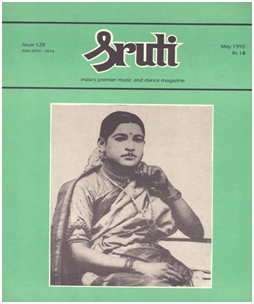
I mentioned my great-grandfather in a previous post. My grandmother had given me a photocopy of a magazine called "Sruti," which bills itself as "India's premier music and dance magazine." It is focused on classical Indian music and the cover story in May 1995 was all about my great-grandfather, Professor R. Srinivasan. Yes, that's him on the cover (if you read the article, you will discover that at the turn of the century, women were not allowed to act on stage and so men had to play women's roles. That's him in some play!). The article is based on an interview with my grandmother (his daughter) and is quite detailed in its profile. As part of my desire to archive and make easily accessible information about my family history, I have transcribed the entire article below exactly as it appeared in the magazine, errors and all. I even checked on the magazine's web site and found the issue is not available to buy or read online. So, at the moment, this seems to fall under the "fair use" guidelines. I'll get the whole thing online in multiple parts (it's quite long). So, without further ado ...
Prof. R. Srinivasan
My father, the late Prof. R. Srinivasan, was a versatile person. He had interest in many different fields. It was usually more than a passing interest. Whatever he took up, he had to do it thoroughly and as perfectly as possible. He was very fond of two dicta, which he would often repeat. One was: "One need not do extraordinary things, but do ordinary things extraordinarily well." The other was: "Trifles make perfection, but perfection is not trifle." He followed these in all that he did.
An example of this would be photography. He was a very good photographer. He started this hobby only in 1938 [when he was 51 years of age], but he did well right from the start. He would not only shoot the pictures but also develop and print them himself. He would do each step himself, beginning with developing upto the framing of the photograph. He had bought all the equipment needed for this -- the chemicals, trays of various sizes to wash the negatives, huge bottles for the chemicals, enlarger, and so on. He used a small room next to the bathroom as a dark room, for much water was needed for the process. He would cover the windows with black cloth and do his work after 7:30 pm. I used to be his assistant.
I remember that he made a set of "smoke pattern" photographs during the Kattigai festival, in which the smoke rising from the lamps lit for the occasion were captured by him on film. He sent them to the Illustrated Weekly of India and received a prize for the same. His subjects varied, and included birds, animals, and flowers. Secenery too. Let me tell you to what extent he went in his mad love for photography! He did not know swimming. He would not even take a 'samudra snanam' [a dip in the ocean] which is considered auspicious. Such a man, in order to capture the Kanyakumari temple at an angle from the sea, went on a catamaran to position himself properly for the shot.
This is how he would do everything, perfectly, not neglecting even a minute detail.
Father was born in Srirangam. He studied in the school there and later in Tiruchi. When he was studying in St. Joseph's College, his teachers concluded that an outstanding student like him should go to Madras where he would have more worthy students to compete with. In Madras, he stayed with his maternal uncle in Triplicane and was given admission in mid-term, considering his high grades. He stood first always, and B.N. Rao [Bengal Narasinga Rao, who later became Sir Bengal and served as a diplomat] would come second. He stood first in the Presidency in M.A. (Mathematics). He got a gold medal and a scholarship to study for the ICS examination. In those days, one had to go to London to take the ICS examination. The parents had to give their consent but my grandfather refused to do so, saying that he could not bear to be separated from his son for such a long time. Father never complained that my grand-father spoiled his future. He would say" "I always wanted to become a teacher. So God made this happen; my father was only an instrument." He also felt that, although he might have acquired name and fame by joining the ICS, he would not have been able to work on music or theosophy.
Tuesday, July 19, 2011
Great Grandfather Thoughts
![]() |
| A scan of one of his cards, probably from the 1960s? |
The sage does not talk, the talented ones talk; and stupid ones argue. (Chinese proverb)
To say the right thing at the right time, keep still most of the time. (J.H. Raper)
The greatest glory consists not in never failing, but in rising every time we fall. (Goldsmith)
Wisdom is knowing what to do next, skill is knowing how to do it, virtue is doing it. (D.S. Gordon)
Genius does what it must, talent does what it can.
The secret of life is not to do what you like, but to like what you do. (Henry Davidoff)
"The greatest saint is not one who does extraordinary things, but one who does ordinary things extraordinarily well." (Dr. A. Maclaren)
Sow an act, and you reap a habit,
Sow a habit, and you reap a character,
Sow a character, and you reap a destiny (J. Locke)
"God will not ask thy race,
Nor will He ask thy birth;
Alone will He demand of thee,
'What hast thou done on earth?"
Nothing breeds fatigue like inactivity. (O.A. Batista)
"Rules are for when brains run out" (I have a whole essay I can write on "zero-tolerance policies" that emerge from my belief in this quote)
If man owns land, the land owns him. (Emerson)
Whenever science makes a discover, the devil grabs it while the angels are debating the best way to use it. (Alan Valentine)
People are lonely because they build walls instead of bridges. (J.F. Newton)
Fire tries gold, misery tries brave men. (Seneca)
To sin by silence when they should protest makes cowards out of men.
He has a right to criticise who has a heart to help. (Abraham Lincoln)
There is so much good in the worst of us,
And so much bad in the best of us.
That it ill becomes any of us,
To look down on the rest of us. (C.W. Leadbeater)
Pray as if everything depended on GOD, and work as if everything depended on man. (Spielman)
Troubles like babies grow larger with nursing. (Lady Holland)
Self-confidence is the first requisite to Great undertakings. (Samuel Johnson)
So, which of these are your favorites?
Monday, July 18, 2011
NOSTALGIA
Sunday, July 17, 2011
Back to Blog
![]() |
| Looking through the box, bald spot and all! |
I also read an article in the paper today about research showing that Google is changing the way our brains work (Science, 2011). We tend to allocate our information processing capacity towards things that are important and relevant to us. As Google makes a vast trove of information easily accessible so that we don't have to actually remember all this stuff any more, our brains are diverting their cognitive capacities towards other things - like where stuff is stored (as opposed to WHAT that stuff is).It's true. All the materials I found in this box brought back a flood of memories and I wondered why this information wasn't more easily accessible. I would like to offload some of my memories to the online world so it can be easily accessed by myself and my friends and family in the hope it will keep these bonds through time rather than just when I stumble upon an old box of knick knacks.
Already, Facebook has enabled me to connect with several of the people dusted off from within the box I opened yesterday. What a world! Coincidentally, I watched the movie "Social Network" this weekend. I really believe now that social networking sites like Facebook (or whatever other incarnation happens to dominate in the next decade) are stunning achievements in their ability to connect people not just across space, but across time. Sure, enough has been written about the problems with sites like Facebook, but on days like this, I just marvel at its ability to connect people over the years. I found one person from my past and found he was connected to just one or two other people. Each of those people had connections with just one or two other people from my youth. Within a few hours, I had connected with people from my school, college, and acting group based in different continents.
Then, there is my own stuff. I used to love to write and I found notebooks and typed pages of stuff I wrote in the early eighties. Now, that by itself is not so interesting. What stunned me is that some of those brief essays are astonishingly well written even with my jaded professor's eyes of today. Truly, I am quite stunned at what I wrote when I was 18 years old. Surprisingly, some of the content still seems contemporary and appropriate even today. For example, I found this short essay I wrote called "Nostalgia" which is written from the perspective of an old man looking back at his past and his youth. Now, what could an 18-year-old possibly know about old age and nostalgia? At the "ripe old age" of 44, I am reading this and still can't find much fault with the perspective. And, it seems so well written. I remember writing it, but can't emotionally connect with the person I was when I wrote this. It just seems to be better written than anything I could come up with today. What happened to me?
So, that should prepare you for what is to come on this blog over the next few days/weeks. A documentation of my past, essentially. You'll hear and see from my grand parents, great grand parents, and even the young me. I'll refer to friends and associates (please drop me a note to have any references/links/images redacted) and hopefully build a searchable online repository of my personal history.
So, let's start, quite appropriately, with an essay I wrote (most likely in 1984 or 1985 at the age of 17 or 18) called "Nostalgia." Wait for it tomorrow ...
Thursday, July 14, 2011
What Makes a Best Friend?
I realized that what made this conversation special was that it was comfortable. I never had to think much before responding because I could be exactly who I am without having to put in the effort to sound clever, thoughtful, or deep. I think you have a best friend when you can just be yourself with them and not have to converse on tenterhooks wondering if some part of the interaction is going to hurt you down the line. You feel comfortable with them because you know they like you for who you are.
It's certainly not that best friends are blind to each others faults (I think those friendships rarely last). Rather the opposite. You acknowledge each others quirks and faults and issues and decide that the good outweighs the bad. When you know that they know your quirks and blemishes and faults and are still willing to spend time with you, you have a best friend. Once you know that you don't have to hide your own unique foibles and hangups from your friend because they're not going to reject you for it, you can just be yourself and have the kind of meaningless conversations and leave happy.
I had someone tell me once about their latest beau, "He's perfect. I just can't see any flaws in him." My thought to myself was "Uh, oh." Best friends, in my opinion, do not see each other as perfect or infallible in any way. The key is not to see no flaws, but to see the flaws, acknowledge them, and still decide that the good outweighs the bad and the relationship is worth pursuing. And, it's not even as simple as magnanimously declaring that you see your friend's flaws and accept them. It requires recognizing and accepting your own flaws. We are all quirky, irrational, and flawed in some way and unless we see that we ourselves have just as many quirks as the other party, there is an imbalance that will never lead to that level of "comfort" with the other party with which I started this essay. You not only have to see and accept your friends' flaws, but have to know that they have seen and accepted your flaws. Then you can relax and be yourself and have the sort of relationship of which dreams are made.
This dream relationship is not without fights, arguments or misunderstandings. In fact, I have got extremely irritated with the behavior of my "best friends" more than once. The flaws don't disappear in a BFF relationship. They often rear their head and lead to frustrations and disagreements. But, the difference with a best friend is that you come back. In the midst of your frustration, you know, in the back of your head, that you're not going to to discard the relationship because of this latest tiff. The good outweighs the bad.
That's why, in my obituary, I hope I don't come across as the perfect guy. I'd know people were lying and pretending that I was who I wasn't. Rather, the most honest compliment anyone could give me would be "at heart, he was a nice guy!"
Friday, February 18, 2011
I Hope We Lose Today!
Sometimes, these different perspectives we each have on events crash into each other and give us a glimpse of how different our views are from others. So, last season, I was driving my 8-year-old son to one of his many hockey games and he was chattering away in the back seat. At some point, he proclaims, "I hope we lose our game today!" Confident he was being silly and playing an "opposite game" of some sort, I laughed and said something like "Right, as if you want to lose. You mean, I hope we win big today."
In a perfectly serious voice, he replied "No, Dad. Today I really hope we lose the game."
"Why?" I asked, wondering if there was some turmoil on his team such that he no longer wanted his team to succeed.
"Because my friend Carter is on the team we are playing and I don't want him to feel bad if they lose," he said with utmost sincerity.
All I heard was the crash of clashing perspectives.
Our son's hockey coach forwarded a great little article to all of us parents today and reading it reminded me of this event from last season. It is just a fascinating little piece written by a youth hockey coach. Read through it and tell me what you think:
http://www.truesportpur.ca/en/resources-/stories-6-i-hope-they-didn-t-bring-apple-juice
Friday, January 29, 2010
"Here, Here" for another Grammar Rant
When someone says something you agree with, have you ever said "Here, Here!"? What the heck does that mean? Why would you highlight your location to indicate agreement with another person? Well, you shouldn't.
Technically, what the phrase should say is "Hear, Hear!" Now it makes sense. Someone says something that you agree with and you indicate your support of that point of view by telling other people they should "hear" what has just been said.
Here's what Wikipedia has to say about this phrase:
"Hear, hear is an expression used as a short repeated form of hear him, hear him. It represents a listener's agreement with the point being made by a speaker.
It was originally an imperative for directing attention to speakers, and has since been used, according to the Oxford English Dictionary, as "the regular form of cheering in the House of Commons", with many purposes depending on the intonation of its user. Its use in British Parliament is linked to the fact that applause is normally (though not always) verboten in the chambers of the House of Commons and House of Lords.
It is often incorrectly spelled "here here", especially on websites and IM.
This was just another little annoyance to me (I would constantly read people saying "Here, here" and make some patronizing mental comment about their idiocy) until recently.
Come on, really? Robin Cook? In all fairness, it may be the work of some ignorant editor on the staff of Putnam's books. But seriously, none of the editors on their staff caught this gaffe?
"There, there!"
Sunday, August 9, 2009
Rajiv's Law of Discussion of Issues
The amount of outrage expressed by a person on any complex issue is inversely proportional to their understanding of it.
Friday, June 26, 2009
You must not of learned much!
I am guessing that it is because of the SOUND of the word, people have written things like "I must of learned something in class," or "You should of come over yesterday," or "You must of stayed out late last night."
What is the deal here? Surely when you write it you realize how stupid it looks and sounds? If you can't figure out when to use "have," just go ahead and use a contraction like "must've" or "should've" even though I'm not a huge fan of that usage.
Phew! That feels better ...
And while we're at it, people PLEASE, PLEASE, PLEASE ...
This post cannot peek your interest, but it certainly can pique your interest.
Monday, November 3, 2008
Books ...
Predictably Irrational
Nudge: Improving Decisions about Health, Wealth, and Happiness
Some books I want to read
Buyology: Truth and Lies about Why We Buy
Call of the Mall
Guesstimation: Solving the World's Problems on the Back of a Cocktail Napkin
Impossible?: Surprising Solutions to Counterintuitive Conundrums
Sway: The Irresistible Pull of Irrational Behavior
The Logic of Life
Don't Believe Everything You Think
Blind Spots: Why Smart People Do Dumb Things
Mistakes Were Made (But Not By Me)
Innumeracy
Irreligion
Crimes Against Logic
Everything You Know About God Is Wrong
Gut Feelings
The Black Swan
The Two Headed Quarter
Thinking and Deciding
More Damned Lies and Statistics
Statistics and Data Analysis: From Elementary to Intermediate
Simple Heuristics That Make Us Smart
Tuesday, September 16, 2008
Open Letter to Vikings Owner Zygi Wilf
Yes, I know how the sunk cost effect and commitment/consistency theory make it difficult for you to pull the plug on Mr. Dead Man Walking (oops, I meant Mr. Childress). But, please have some pity on Mr. I Just Need to Play Better (a.k.a Mr. Tarvaris Jackson) and put a merciful end to their suffering? And, it may just minimize the misery of another lost season for us Vikings fans.
Actually, you know what terrifies me more than a string of losses this year? A string of wins this year. I am dreading the idea of your continued support for a clueless coach (and let’s not forget his “system”) and an incompetent QB instead of stopping the bleeding right now. I worry that you will feed this team some hemorrhaging medicine that results in a few victories in a row so they end up with a spectacular 9-7 season. Then, what if they somehow make the playoffs. Isn’t it going to be so much harder to fire them then? Why not rip the Band-Aid off now and give all of us some shred of hope for next year?
Let’s give credit where it is due. First, I am sure that Mr. Childress DOES have a brilliant offensive “system.” Too bad it is a LOSING SYSTEM. Second, I am sure that Mr. Jackson is the physical prototype of an NFL QB. Too bad that most of his muscle is between his ears. Third, let’s talk about prized free-agent signing, Mr. Bernard Berrian. Yes, I am sure he is fast. Too bad he’s so fast that his right foot managed to trip up his left foot on the one deep pass that poor Mr. Jackson tried to throw. Finally, let’s talk about the other prominent signing recommended by Mr. Childress. Yes, the guy who dropped the eminently catchable pass in the end zone against the Colts. Visanthe … Wait, isn’t his nickname “Vise-Grip” Shiancoe? ‘Nuff said.
Mr. Wilf, you nobly backed coach Childress when he asked you to open up your pocketbook and pay a fortune for big-name free agent signings. Your loyalty was impressive when you trusted coach Childress who claimed that he had the skill to identify and groom a top notch quarterback in Tarvaris Jackson. I saw you smiling and nodding your head when you stood beside the coach as he talked about how improved Jackson was and how ready he is to lead the offense this year.
Sorry to sound pedantic, but attribution theory (see Kelley 1967) suggests that when consistency is high (Childress’ coaching performance is equally incompetent in different game situations and over multiple years), distinctiveness is low (Childress’ displays the same ineptitude in every phase of the game – whether it be offensive pass effectiveness or defensive pass coverage – and against any team he plays), and consensus is low (other teams – even ones that perform pathetically against other teams – look like superstars against a Childress-coached Vikings), it is reasonable to make an internal attribution (the cause of the failure is Childress). Kelley (1967) says that when the information available forms such a pattern, a clear attribution can be made to the “actor” (Childress). My guess is that a simple analysis of the pattern of information relating to Tarvaris Jackson will also allow you to make a clear attribution as to his role in this fiasco. Given coach Childress’ degree in psychology, this research may actually be familiar to him.
Perhaps I can appeal to your sense of outrage to overcome the normal resistance to going back on your “support” for coach Childress. You gave this man everything he wanted in order to build a contending team today. It is clear you opened your pocketbook to buy him all the toys he could demand to make his mysterious “system” work. Given that his system (which seems to basically consist of carefully concealing his mouth so no one steals his electric plays) has been given many opportunities to prove itself and he cannot blame it on a lack of talented players, maybe it is time to question whether the system works. In fact, how about we even question whether there IS a system in the first place. You know what, I suspect the reason coach Childress covered his mouth when relaying plays is because he wanted to hide the fact that he hadn’t come up with a single play yet! I can imagine coach Childress covering his mouth and muttering “Okay, I’ve got my mouth covered, you think anyone knows that I don’t have any brilliant play thought up yet? What can we do? Hey, how about having our superstar speedster Adrian Peterson run up the middle? Make sure you ask him to find the thickest part of the pile up and run straight towards it with his head down?” Poor Adrian probably hasn’t been executing the way he has been asked to execute by the coach.
Monday, August 20, 2007
Driving Me To Drink!
Re-read that paragraph above and imagine yourself as the Dad in that situation.
Did you realize that you have just committed an illegal act?
Bizarre as it may seem, it appears that driving someone (who is of legal drinking age) to a liquor store if you are underage is illegal. Notre Dame quarterback, Jimmy Clausen found that out when he was arrested as he was waiting outside in his car while his 23-year-old friend bought some liquor at a store. He said he was just driving his friend to the store and the arresting officers admit that there was no evidence that the liquor was for any minor consumption. Still, they arrested him, charged him with the offense, and had him pay a fine of $170.
I don't get it. Sometimes we go so crazy over protecting our kids from drinking that we reach ridiculous extremes. You can read the full story on ESPN here.
Tuesday, August 14, 2007
Trust No One
Why? Most homework assignments were not turned in and the rest were turned in late!
How can that be? I don't get it. Isn't it reasonable to expect some effort at ensuring that the homework gets done on time and is done correctly?