Please see Part 1 and Part 2 of this profile of my great-grandfather.
PART 3
Prof. R. Srinivasan
(1887-1975)
-------------------
Patron & Promoter of Music
-------------------


Prof. R. Srinivasan
(1887-1975)
-------------------
Patron & Promoter of Music
-------------------
The royal family of Travancore held Father in high esteem because of his sangeeta gnanam. He was often asked to assist the palace in arranging musical events.
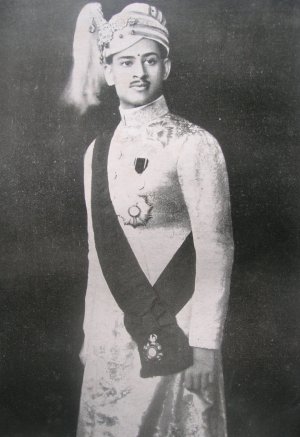
When 16-year-old Chithira Tirunal ascended the throne, the cultural celebrations for the coronation function were all organised by Father. Kater, when the wedding of Kartigai Tirunal, Chithira Tiruanal's sister, took place over a periopd of seven or eight days, it was Father who organised all the concerts. Earlier, when the Regent Maharani was ruling the State, she presented Father, in recognition of his contributions, with a Veera Sanklai and a gold medal with the face of Chithira Tirunal embossed on it.
Father did a great deal for music and musicians, especially in Tiruvanantapuram. He was a good organiser and arranged performance opportunities for local musicians. He used to conduct an arts festival every year, spanning three or four days, at the Victoria Jubilee Town Hall. Featured in it were local talent as well as 'big' musicians from out of town, of Hindustani and Carnatic styles. Abdul Karim Khan performed one year. I remember he sang Kalaharana melara in Suddha Saveri. Also featured were dramas including English plays.
There was no connection between this arts festival and the temple concerts. It was after musicians had been appointed as Palace vidwans that they performed in the navaratri mandapam in the temple, during navaratri.
I can say that Father was a key figure in popularising music in Tiruvanantapuram. When he first arranged a concert with tickets in an auditorium, people asked: "Who will pay to listen to music?" With that beginning, if music has become so widely prevalent in Tiruvanantapuram, it was Father who was responsible.
On one occasion, the Palace authorities called Father and asked for his ideas to make Swati Tirunal's compositions popular. In Travancore, there were many schools, even in small villages in the interior, and music was a compulsory subject in the curriculum. Father's idea was to start a summer school in the capital, where all the music teachers from these schools would be taught Swati Tirunal's compositions so that they, in turn, teach the songs to the children in their schools. I don't remember the year. The principal of this summer school was Narayanan Kutty Bhagavatar, a violin vidwan. (He along with his two younger brothers -- flutist Padmanabha Iyer and Bhagavateeswaran, who played the mridangam and also the veena -- were known as the Tiruvanantapuram brothers. His daughter is the wife of mridanga chakravarti T.K. Murthy). The summer school was conducted for two years. But it was not successful. There was no follow-up to ascertain the results in the field. The Maharani was not satisfied. It was then that Father suggested that they start a regular school -- the Swati Tirunal Music Academy -- bring a renowned vidwan from outside as the Principal and appoint professors of music as well. The proposal was accepted and implemented by the Government. Harikesanallur Muthiah Bhagavatar came as the first Principal of the Academy at the personal request of Father. There were four professors: K.R. Kumaraswamy, N.V. Narayana Bhagavatar (a disciple of Muthiah Bhagavatar), N.G. Seetharaman (Musiri's disciple), and C.S. Krishna Iyer from Palakkad. After about four years, Muthiah Bhagavatar also worked hard to bring out a book of Swati Tirunal's compositions with notation. But he could not complete the work because he fell ill. Then Semmangudi Srinivasa Iyer became the Principal. It was during his tenure that this book was published. Later, additional volumes were brought out. In this way Swati Tuirunal's compositions became popular. It helped a great deal that great musicians assisted in preparing the correct pathantara for the songs.
It was also on Father's suggestion that senior musicians were appointed as palace vidwans, Ariyakudi, Musiri, Semmangudi, Papa Venkataramaiah and Tanjavur Vaidyanatha Iyer were among those who were appointed.
A music festival began to be conducted during the nine days of the Navaratri, in a special place in the the Padmanabhaswamy Temple. Musicians would perform every evening in front of the deity. Swati Tirunal's Navaratri kritis were given prominence -- the particular composition of that day would be the main item -- in the place of ragam-tanam-pallavi. The Maharaja and the Maharani would themselves be present on those occasions. There was a separate enclosure for invitees. As a child, I attended many of these performances, The festival was the idea of the Maharani, a very shrewd and intelligent lady. Whatever suggestions she gave would be such that no one could argue about it.
These Navaratri concerts were another way of propogating Swati Tirunal's songs. Father had a part in organising these programmes also. During the festival period, he also arranged concerts in our own house in which local musicians participated.
All vidwans who visited Tiruvanantapuram would invariably stay in our house. And while staying with us, they sometimes used to give performances in the evening. Ariyakudi Ramanuja Iyengar, Musiri Subrahmania Iyer, among others, have stayed with us and I got the opportunity to move closely with these stalwarts.
All the vidwans used to laugh and joke with us. Rajamanickam Pillai, especially, was very entertaining.

In playing host to the musicians, Father had the full support of my mother. Catering to the needs of all the guests was not an easy task! My mother used to make tinsful of sweets and savouries in preparation for their arrival. Father had given them so much liberty that they would arrive asking: "What have you made specially for us, Manni?" Their timings were erratic , and they themselves would have visitors, and we had to cater to them as well! Of course, we had a cook, but my mother needed immense patience to manage all this very well. For example, Ariyakudi Ramanuja Iyengar preferred to have his dinner after his concert. In those days, concerts used to begin at eight in the evening and end at midnight, and he used to have his dinner at one o'clock in the morning! Such was the supportive role played by my mother, in allowing Father to entertain the musicians and give them the run of our house! Servants also used to be very cooperative in those days, which we cannot expect in today's world.
Father's love of music found expression in many ways. If anyone went by singing, even if it was a beggar, he would call him and give him, food, clothing, etc. One day, a husband-wife 'bairagi' duo came a-singing. Their songs were so good that Father learnt two of then by making the duo sing them three or four times. Not conversant with Hindi, he wrote lyrics in Sanskrit or Tamil to the same tunes.
Later, when we were in Madras, we used to hold bhajan singing sessions every Ekadasi day. Many friends used to attend. Papanasam Sivan too attended a number of these functions.
Father was fond of Hindustani music too. He had gramaphone records of some of the well-known singers of those days. He made me learn two of Bal Gandharva's songs, which were his favourites, and would listen to my singing them often. We didn't know Hindi or Marathi, but I just picked up the words as I heard them and sang, giving importance to the tune. The two songs were Malaa madan basey in Mand and Murthy manta in Bheempalasi. Then whenever I used to sing tukkadas in Mand raga, I used to incorporate the brigas I had learned from Bal Gandharva's songs.

